
Which Sterilizer Do You Have? A Guide to Sterilizer Types and Brands
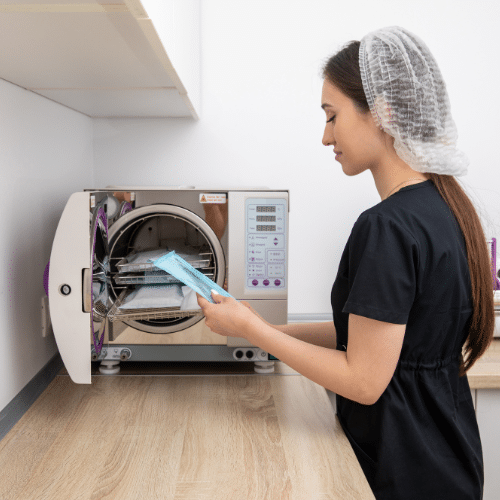
Most offices use one of three types of tabletop sterilizer: steam (an autoclave), dry heat, or unsaturated chemical vapor. Knowing which one you have decides which spore test strip is used, how long your results take, and what your state board expects to see in your records.
It sounds simple, but we regularly receive spore test envelopes marked “Unknown,” or with a steam sterilizer listed as dry heat. This guide shows you how to tell the types apart, lists the brands you’re most likely to see, and explains where to find the details we ask for on every SporeAlert envelope.
How to tell at a glance
The quickest clue is what goes into the machine: water means steam, a special chemical solution means chemical vapor, and nothing at all means dry heat.
| If your sterilizer… | It’s most likely | Examples |
|---|---|---|
| Has a water reservoir you fill with distilled water, and releases steam or water at the end of a cycle | Steam (autoclave) | Midmark M9 or M11, Tuttnauer, SciCan Statim |
| Uses no water or chemicals, gets very hot, and finishes with instruments completely dry | Dry heat | Cox RapidHeat, Dentronix DDS |
| Uses a bottled sterilant solution (such as Vapo-Steril or Vapocide) and has a noticeable chemical smell | Unsaturated chemical vapor | Harvey Chemiclave |
| Uses gas cartridges or a hydrogen peroxide cartridge, and is used for heat-sensitive items | Ethylene oxide (EtO) or low-temperature hydrogen peroxide | Anprolene, STERRAD, V-PRO |
Steam sterilizers (autoclaves)
Steam is by far the most common type in dental, medical, veterinary and body art offices. An autoclave heats distilled water into pressurized steam, usually at 121–134°C (250–273°F), which kills microorganisms quickly and reliably.
How to recognize one
- You fill a reservoir with distilled water, or the unit is plumbed to a water supply.
- The display or manual mentions pressure (psi or bar) and cycles such as “Unwrapped,” “Pouches” or “Packs.”
- You see or hear steam venting, and instruments may be slightly damp before the dry cycle finishes.
- A compact unit with a slide-in cassette instead of a chamber door (such as a SciCan Statim) is still a steam sterilizer.
Kinds of steam sterilizer
- Gravity displacement: steam pushes air out of the chamber. Most traditional tabletop autoclaves work this way.
- Pre-vacuum (dynamic air removal): a pump removes air before steam goes in, so steam reaches inside packs and hollow instruments faster. Often labeled “Class B” or “vacuum.”
- Cassette (steam-flush pressure-pulse): small, fast units that sterilize instruments in a removable cassette.
All three are tested with the same steam spore strips, so you only need to tell us it’s steam.
Common steam sterilizer brands
- Midmark – M3, M7 SpeedClave, M9 and M11 UltraClave (also older Ritter models)
- SciCan – Statim cassette autoclaves (2000, 5000, 6000, 7000) and Bravo chamber autoclaves
- Tuttnauer – the 1730, 2340, 2540 and 3870 “Valueklave” and “EZ” series, plus Elara and T-Edge
- Pelton & Crane – Validator, OCR and Magnaclave (many still in use, though no longer made)
- W&H – Lisa and Lina
- Melag – Vacuklav and Euroklav
- Harvey – Climaclave and PV Dry (older steam models)
- Eschmann, Euronda and Mocom
- STERIS and Getinge large-capacity units in hospitals and surgery centers
- Private-label units sold by dental and medical suppliers, often made by one of the companies above
Dry heat sterilizers
Dry heat sterilizers use only hot air, with no water, steam or chemicals. They run hotter than autoclaves, typically 160–190°C (320–375°F), and are popular in orthodontic offices because they don’t rust or dull instruments.
How to recognize one
- There’s no water reservoir, drain or sterilant bottle.
- Instruments come out bone dry and very hot.
- The manual or label says “dry heat,” “hot air,” “rapid heat transfer” or “forced air.”
- Cycle times are either very short (6–12 minutes for rapid heat transfer) or long (an hour or more for oven-style units).
Kinds of dry heat sterilizer
- Rapid heat transfer (forced air): a fan moves hot air at high speed for short cycles.
- Static air (oven type): heats like an oven, with much longer cycles.
Common dry heat sterilizer brands
- CPAC – Cox RapidHeat (Cox 6000 and earlier models), Steri-Dent and SteriSURE
- Dentronix – DDS 5000 and DDS 7000 series
- Harvey / Barnstead – older Dryclave models
- Static-air ovens from medical and laboratory suppliers
Dry heat is tested with a different spore than steam, so it’s important to mark it correctly on your envelope.
Unsaturated chemical vapor sterilizers (“Chemiclaves”)
Chemical vapor sterilizers heat a special solution of alcohols, formaldehyde and a small amount of water under pressure, at about 132°C (270°F). Because the vapor holds very little water, instruments come out dry and don’t rust.
How to recognize one
- You fill it from a bottle of sterilant solution (such as Vapo-Steril or Vapocide), not distilled water.
- It has a chemical smell, and many have a vapor filter or “Chemi-Purge” system.
- The label or manual says “Chemiclave” or “chemical vapor.”
Common chemical vapor sterilizer brands
- Harvey Chemiclave (made at various times by MDT, Barnstead/Thermolyne and Thermo Fisher) – Model D, MDT 5000, 5500 and 6000, and EC5500 and EC6000
Chemiclaves are no longer manufactured, but many are still in service with parts and solution available. On our forms they’re listed as Chemical, and they’re tested with the same type of spore as steam.
Low-temperature sterilizers: ethylene oxide and hydrogen peroxide
Hospitals, surgery centers, veterinary practices and manufacturers sometimes use low-temperature sterilizers for items that can’t take heat, such as plastics, scopes and electronics. You’ll rarely find these in a dental or tattoo office.
Ethylene oxide (EtO)
- Uses a gas cartridge or ampule; loads need hours of aeration afterward.
- Brands: Andersen (Anprolene) and 3M Steri-Vac. 3M discontinued the Steri-Vac in May 2025, but existing units may still be in use.
Hydrogen peroxide (vaporized or gas plasma)
- Uses a hydrogen peroxide cassette or cartridge; cycles run at about 50°C.
- Brands: ASP (STERRAD) and STERIS (V-PRO).
On our forms, EtO and other low-temperature methods are tested with the longer “Dry Heat & Other” turnaround. If you’re not sure your unit is one we can test, call us before you mail a sample.
Finding your sterilizer’s make, model and serial number
Every sterilizer has a data plate: a metal or foil label with the manufacturer, model, serial number and electrical details. It’s usually on the back, on one side, or inside the door frame.
- Check the back and sides of the unit first, then inside the door. On cassette units like the Statim, look on the back panel.
- Write down the manufacturer, the model (for example “M11” or “2340EA”), and the serial number exactly as printed.
- If the plate is worn or hidden, look in the owner’s manual or on your purchase invoice, or ask your equipment dealer or service technician.
- Still unsure of the type? Search the model number with the word “sterilizer.” The manufacturer’s page will say steam, dry heat or chemical vapor.
- If you have more than one sterilizer, give each one a name (“Op 2 Statim,” “Back M11”) and use it every time. This keeps each unit’s spore test history separate.
Use the same details on every envelope. Consistent information lets us match your results to the right sterilizer and keep your records clean for inspections.
What your sterilizer type means for spore testing
The CDC recommends testing every sterilizer at least weekly with a spore test and a matching control. SporeAlert strips work with any commercial sterilizer, but the type you mark on the envelope tells our lab how to process your test and how long it takes.
| Sterilizer type | Spores that test it | Results emailed in |
|---|---|---|
| Steam | Geobacillus stearothermophilus | 24 hours |
| Chemical vapor | Geobacillus stearothermophilus | 72 hours |
| Dry heat, EtO and other | Bacillus atrophaeus | 7 days |
All tests are set the same day we receive them. If a test fails, we call and email you the same day.
When you fill out your envelope:
- Tick the sterilizer type that matches your unit. If it’s not clear, use the table at the top of this article.
- Add the make, model and serial number from the data plate, plus the name you use for that unit.
- Write the date you ran the test, and mail the envelope promptly.
Still not sure?
We’re happy to help. Send us a photo of your sterilizer’s front and data plate, or call with the brand and model, and our microbiologists will tell you which type it is and how to mark your envelopes.
- Call 1-800-647-9881 (Mon–Thu 9 AM–4 PM, Fri 9 AM–12 PM Pacific)
- Email frontdesk@woodhouselabs.com
Ready to test? Order SporeAlert spore tests or see options and prices.
Sources
- CDC: Best Practices for Sterilization Monitoring in Dental Settings
- CDC: Sterilization and Disinfection (dental infection control summary)
- Dentalcare.com: Biological indicators for steam, chemical vapor and dry heat
- CPAC: Cox RapidHeat product catalog
- Alfa Medical: Harvey Chemiclave models no longer manufactured
- 3M: Steri-Vac discontinuation notice
Need a lab you can count on?
SporeAlert mail-in spore testing and BiofilmAlert waterline testing, with results emailed for every report and a real person on the phone when it matters.